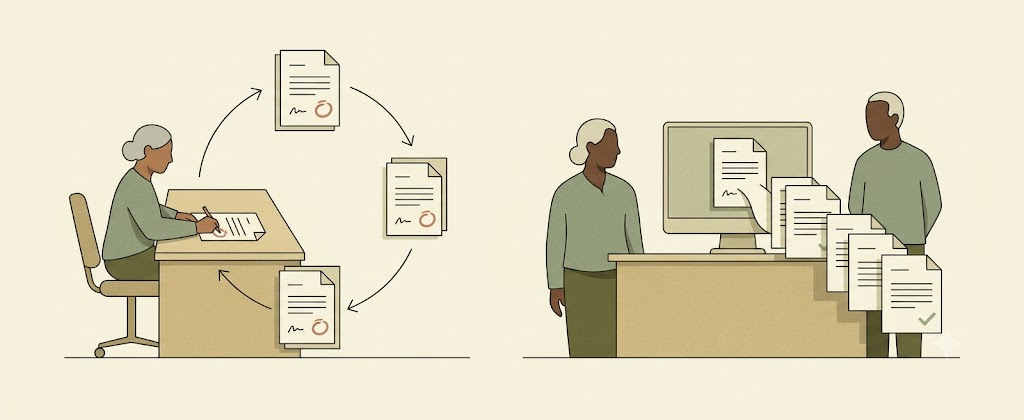
There's a moment that happens in nearly every firm with a review step, and it's so routine that nobody thinks of it as a problem. A senior person checks a piece of work, finds an error they've seen before, and fixes it. They don't flag it, they don't explain it — they just correct it, because under deadline it's faster to fix the thing than to teach someone why it was wrong. The work goes out clean. The client never knows. And next month the same error comes back, because nothing about the process changed.
It's worth sitting with how expensive that loop is, precisely because it's invisible.
The cost isn't in any single correction — each one takes a few minutes. The cost is in the repetition, and in who's paying it. Your most senior, most expensive people spend a slice of every week re-correcting errors that should have stopped recurring long ago. The knowledge of what went wrong never leaves the reviewer's head and their red pen, so it can't accumulate anywhere. The person who made the mistake doesn't reliably learn not to make it again, because the feedback never quite reaches them. And the firm gets no compounding benefit from any of it — the same lesson is paid for, in senior time, again and again.
What makes this so easy to miss is that the output is always fine. Quality isn't the problem. By the time anything reaches a client it's correct, because the reviewer caught it — that's their job, and they're good at it. So it never shows up as a complaint, never appears on a report, never triggers a review of the process. The firm is quietly subsidising the gap between "we produce good work" and "we produce it efficiently," and it's subsidising it with the time of exactly the people it can least afford to spend that way.
That's the recognition worth having: most firms don't have a problem with the quality of what they produce. They have a problem with where the cost of that quality lands — on the wrong people, repeatedly, in a way that no amount of working harder will fix, because the issue is structural rather than personal.